Three weeks out, most parents of a four- or five-year-old go looking for books about starting kindergarten and find the same twenty titles on every list, undifferentiated. They are not the same book. Some walk a child through the actual sequence of the day — the peg, the carpet, the toilets, the moment you leave. Others are about the feeling: I will miss you, I am small, everyone else looks bigger.
A worried child usually needs the first kind. A worried child is usually given the second.
Below are eight books sorted by which of those two jobs they do, a table for working out which one your child is asking for, and an honest answer on when to start reading them — because starting too early has a cost nobody warns you about.
Which kind of book does my child actually need?#
Listen to the shape of the question they ask at bedtime. It tells you which book to buy more reliably than any age band. The ages below are our call on where each book lands in a real room; where a publisher states its own banding, we have said so.
| What your child says or does | What is actually missing | Read them | Ages |
|---|---|---|---|
| "Where do I put my coat?" · "What if I can't find the toilets?" | Information. The day is a blank, and a blank fills with monsters | Welcome to Kindergarten · Miss Bindergarten Gets Ready for Kindergarten | 3–6 |
| "Will you stay with me?" · goes quiet at the word goodbye | A goodbye with a shape — and something to hold on to at 10:40am | The Kissing Hand · Llama Llama Misses Mama | 3–6 |
| "What if nobody plays with me?" | Proof that every child arrives knowing nobody | Miss Bindergarten · The King of Kindergarten | 3–6 |
| Says nothing at all, then will not go to sleep | The whole day narrated end to end, pickup included | The King of Kindergarten · The Night Before Kindergarten | 4–6 |
| Worries about everything, and always has | Words for the worrying itself | Wemberly Worried | 4–7 |
| Has already started, and is oddly quiet about it | Proof they were not the only one | First Day Jitters | 5+ |
Most children in the United States meet this at five. The American Academy of Pediatrics states on HealthyChildren.org that "in most parts of the country, these age requirements are 5 years old for kindergarten and 6 years old for first grade."
Why do the rehearsal books work harder than the feeling books?#
The best evidence that a picture book can lower a small child's anxiety before a frightening event does not come from education research. It comes from an operating theatre.
The trial. In a randomised controlled trial published in BMC Pediatrics in 2022, 131 children aged three to six who were booked in for minor surgery were split into two groups. One group was posted an animated picture book a week beforehand, telling the story of a rabbit called Tom who goes through each event of the day in order.
The result. The children who had read it scored lower on measured anxiety in the operating room before cannulation (51.9 against 67.2, p=0.001), and fewer resisted at the moment of anaesthesia (21% against 38%). The authors of the BMC Pediatrics trial concluded that home-reading the book "to get familiar with the perioperative events earlier prior to surgery could effectively reduce the preoperative anxiety level".
What the book had to contain. Not reassurance. A sequence. The rabbit did the things in the order the child would do them — which is exactly what a classroom tour, or a narrated first day, does for a school gate.
The feeling books are not useless. They work by a different route. In PLOS ONE in 2023, Schoppmann and colleagues read 3-year-olds a picture book in which the character used distraction to get through a wait, and found those children then used distraction more themselves, concluding that picture book reading "could be an ecologically valid and versatile method for supporting 3-year-old children in their use of an age-appropriate adaptive emotion regulation strategies such as distraction". Note what the book had to do: show the character using a strategy. Not name the feeling.
So there are three kinds of book on that library display, not one. Books that walk the sequence. Books that hand over an action. And books whose entire content is starting school is a big feeling — the weakest of the three, and the one most often given, because it is the one that makes the adult feel better.
Books that rehearse the day#
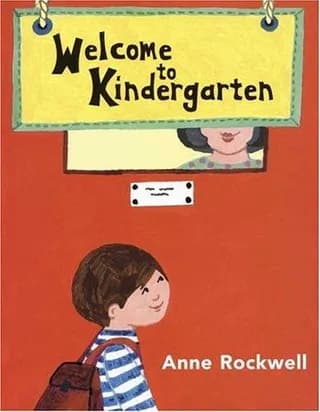
Welcome to Kindergarten#
- Written by
- Anne Rockwell
- First published
- 2001
- Ages
- 3–6
- Format
- Picture book
Anne Rockwell's book is almost plotless on purpose: a boy visits the classroom he will be in after the summer and finds out what is waiting there. Nothing happens, and nothing needs to. It is a floor plan with a story draped over it, which is the single most useful thing you can hand a child who keeps asking where things are.
Reading it aloud: stop on every page and say where the same thing will be at your child's school. This is the one book here that gets better the more you interrupt it.
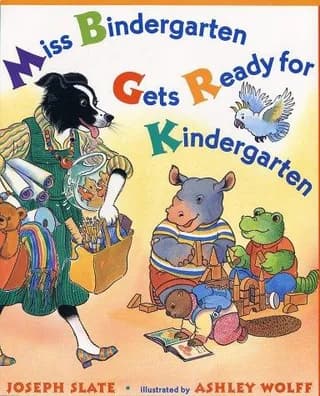
Miss Bindergarten Gets Ready for Kindergarten#
- Written by
- Joseph Slate
- Illustrated by
- Ashley Wolff
- First published
- 1996
- Ages
- 3–6
- Format
- Picture book
Twenty-six children — one per letter — all getting ready on the same morning, while the teacher sets up the room they are heading for. Joseph Slate and Ashley Wolff use the alphabet as scaffolding rather than as a lesson, so nobody is being taught anything.
Reading it aloud: the most useful line is not in the book. It is you saying, "look, they are all getting ready today." A four-year-old's private theory is that every other child already knows how school works.
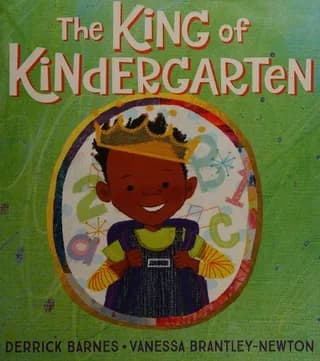
The King of Kindergarten#
- Written by
- Derrick Barnes
- Illustrated by
- Vanessa Brantley-Newton
- First published
- 2019
- Ages
- 3–6
- Format
- Picture book
Derrick Barnes and Vanessa Brantley-Newton take one boy through one whole day. His mother names him King of Kindergarten at breakfast, and he wears it through the towering doors, the new names, lunch, the royal rest and the journey home. Penguin Random House bands it 3–6.
It is the best-written book on this list, and the only one whose register is not anxious. The day is not survived. It is presided over.
Reading it aloud: use the biggest voice you own on the first page and do not soften it later. The tone is the argument.
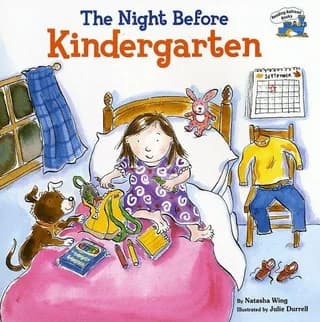
The Night Before Kindergarten#
- Written by
- Natasha Wing
- Illustrated by
- Julie Durrell
- First published
- 2001
- Ages
- 4–6
- Format
- Picture book
Natasha Wing and Julie Durrell cover the last twelve hours in the metre of The Night Before Christmas: packing the bag, the photographs, the goodbye. Its catalogue description gives away the joke — the children prepare for kindergarten, and "the parents are the ones who have trouble adjusting."
An honest note: the crying-parents page is either a gift or a landmine, and which one depends entirely on your child. Some find it hilarious that adults cry. Some file it as evidence that something bad is coming. Read it to yourself first.
Books that hand your child something to do#
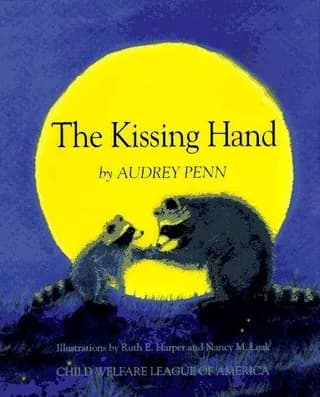
The Kissing Hand#
- Written by
- Audrey Penn
- Illustrated by
- Ruth E. Harper and Nancy M. Leak
- First published
- 1993
- Ages
- 3–7
- Format
- Picture book
Chester the raccoon does not want to go to school, so his mother kisses the palm of his hand and tells him he can press it to his cheek whenever he needs to. Published in 1993, and still the book most likely to be handed to you by a teacher. Tanglewood bands it 3–7.
Where we disagree with the consensus: it is praised as a book about missing your mother, and that is the weakest thing in it. The valuable part is the palm — a physical action a child can perform at 10:40 in the morning without asking permission — a strategy modelled in a book and then borrowed, which is the mechanism the PLOS ONE distraction study measured. Read it and skip the ritual, and you have read a sad book about separation to a child who was not thinking about separation.
Reading it aloud: do the kiss on their palm at the page where it happens, then again at the real gate on the real morning. The book is the instruction manual. The gate is the book.
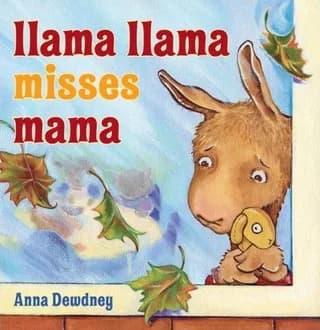
Llama Llama Misses Mama#
- Written by
- Anna Dewdney
- First published
- 2009
- Ages
- 2–5
- Format
- Picture book
Anna Dewdney's llama is dropped off, panics, plays anyway, and is collected. Strictly it is a nursery book rather than a kindergarten one, and that is why it is here: it is the one on this list a not-quite-four-year-old will sit through, and the rhythm does the carrying.
Reading it aloud: the last page is the whole book. Say "and Mama came back" in exactly the same voice every time, until it is boring. Boring is the goal — you are building a rule, not a moment.
Books that name the feeling#
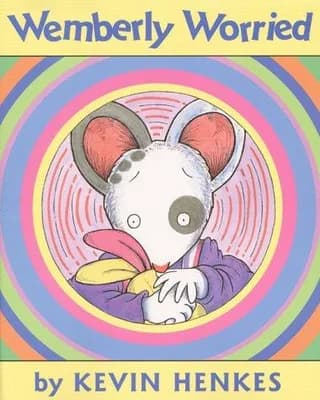
Wemberly Worried#
- Written by
- Kevin Henkes
- First published
- 2000
- Ages
- 4–7
- Format
- Picture book
Kevin Henkes's mouse worries about everything, and the book is unusually honest: the worrying does not stop, she simply finds someone who worries too. For a child whose anxiety is a temperament rather than a one-off, this is the most accurate book here.
Reading it aloud: resist the urge to solve it. Wemberly's worries are never argued away, and a child who worries has heard "there's nothing to worry about" often enough to have stopped believing it.
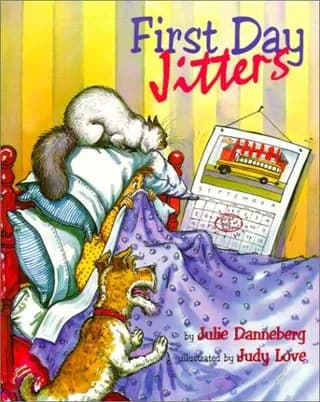
First Day Jitters#
- Written by
- Julie Danneberg
- Illustrated by
- Judy Love
- First published
- 2000
- Ages
- 5+
- Format
- Picture book
Julie Danneberg and Judy Love's book has a twist: the person refusing to get out of bed turns out to be the teacher. Charlesbridge bands it 5+.
When not to read it: not in the last week of August. The joke needs a child who already has a mental model of a first day. It works far better in week one, as proof that the nerves were shared by everyone in the room, including the adult at the front.
When should we start reading them?#
The one hard anchor we have. In the BMC Pediatrics trial, the book went home to families one week before the event. Not a season before. One week.
Our rule: two or three weeks, then stop escalating. Long enough for a book to become familiar, short enough that school stays a thing with a date on it.
Too early has a cost that too late does not. A four-year-old has no working calendar. If the school books arrive in June, school becomes a thing permanently about to happen and never happening, and the dread has ten weeks to compound. That is our judgement rather than a research finding — but it is consistent with what the trial tested, which was familiarity a week out, not a summer of preparation.
The rehearsal books can start earlier than the feeling books. A book about where the coats go is information, and it ages well. A book about missing your mother is an emotional prompt, and reading it in July can hand a child a worry they had not yet had.
Keep one back for week three. The wobble returns once the novelty wears off, and the book that worked in August works again then — with the advantage that by that point your child can correct it.
How do I read a first-day book so it actually helps?#
Rename everything as you go. Say the real school, the real teacher, the real gate. The trial's book worked because it named the events the child was about to meet, and a book that says "school" is doing half the job of a book that says "Miss Kelly".
Let them tell it back. By the third reading, stop and ask what comes next. Reading Rockets, the literacy service published by WETA in Washington, D.C., calls this dialogic reading and describes it plainly: "the adult helps the child become the teller of the story."
Finish on pickup. Every time. The worry is almost never about school. It is about whether you come back. If the book ends at the classroom door, add the sentence yourself.
Reread one book rather than buying six. Familiarity is the active ingredient, and it only accrues to a book you have read a dozen times.
What to read next#
- Your child is starting school rather than kindergarten specifically → a book for a child starting school covers the September version, and what to put in the story.
- You want the wider shelf → the best children's books of all time, sorted by the age each one actually lands at.
- You are choosing a present rather than a preparation → the personalized book gift guide.
- You are weighing up the tools → what a children's book generator can and cannot do.
Can a book where my child is the main character name their actual teacher?#
Before anything else, the decision. Who each of these is for:
- Asking practical questions → Welcome to Kindergarten, then Miss Bindergarten.
- Cannot say goodbye → The Kissing Hand, and Llama Llama Misses Mama if they are on the young side.
- Has gone quiet → The King of Kindergarten, for the tone as much as the sequence.
- Worries as a matter of course → Wemberly Worried.
- Has already started → First Day Jitters, in week one.
And here is what none of them can do. Rehearsal works by specificity — the trial's book earned its result by naming each event in the order the child would meet it. Every book above names somebody else's day, at somebody else's school, starring a raccoon or a mouse or a boy who is not yours. It cannot say Miss Kelly, or the green gate past the bakery, or and the toilets are the thing you are actually frightened of.
A book where my child is the main character can say all three, because you write the brief.
That is what we make at KindFable. You upload one photo, type a few lines about your child — the school, the teacher, the friend from nursery, the thing they keep asking at bedtime — and we paint them as the hero of a full 32-page storybook. Not a name dropped into a template: their face, drawn as a character, on every page, with up to three companions beside them. The little brother in the buggy. Grandma, who is doing pickup.
Here is a complete one, and it is deliberately not a school book. Wren is six, and what her parents wrote was that she had got her own library card, printed her name on the line herself, then borrowed nine books because she checked and nine was the maximum. That is the shape a first-day book needs: a child doing a hard thing alone, and the proof of it going into her coat pocket.
The actual book
Read it, and hear it
Everything below is the finished book — not a mock-up, not a selection of the good pages. The song is the one the family received.
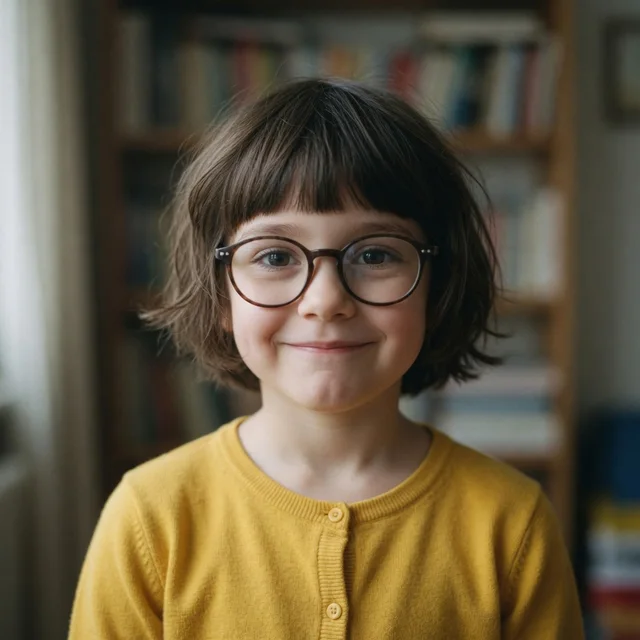
The photo they uploaded
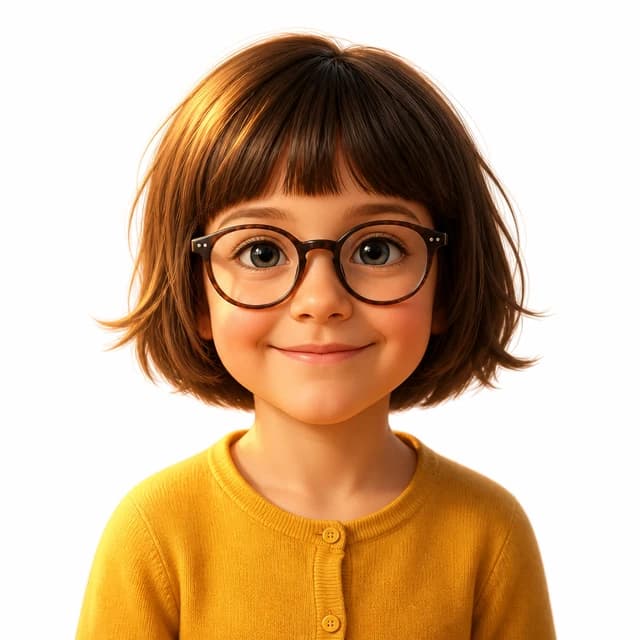
The character we drew
Written from this story — not a stock track with a name dropped in. Free with every book.
The full story, in text
- 1Wren stood in the library, holding a blank card and looking at the waiting line.
- 2The librarian gave Wren the card. A smooth white line waited for her name.
- 3Wren wanted to print her name all by herself, right there on the library card.
- 4Wren pressed the pencil down. Slowly, she printed W, then r, then e, then n.
- 5The last letter landed. Wren lifted the pencil and looked at her name.
- 6There it was, Wren's name, printed by Wren, all by Wren.
- 7Wren tucked the card into her coat pocket, then walked between the shelves to choose books.
- 8One book joined Wren's stack, then another, until the stack grew tall.
- 9Wren counted nine books, the maximum she checked, and carried them to the desk.
- 10The card went into Wren's pocket again. The books came home with her.
- 11Outside, Wren took out the card just to look. Her name sat there, neat and true.
- 12Wren's name was on the library card, and nine books were coming home. Her pocket held a glow.
The words to the song
[Verse 1]
Wren held a blank card in line
The kind librarian gave her a sign
Wren wrote W, then r, e, n
Her name was there, all by Wren

[Chorus]
Wren, Wren, look and see
Your name is bright and neat with glee
Wren, Wren, what a happy day
Nine books are coming home to stay

[Verse 2]
Wren put the card in her coat
And chose books, one by one to tote
One, two, nine books in her stack
Nine was the most she could take back

[Chorus]
Wren, Wren, look and see
Your name is bright and neat with glee
Wren, Wren, your card shines true
A pocket glow comes home with you
On KindFable it goes: name and age, one photo, a tick box for consent, a few lines about the September you are actually facing, and one of nine art styles. You see the cover, painted, before you pay for anything — and the softcover and hardcover prices sit on one page, with every book including its own song free and the hardcover adding the narrated audiobook — which is how a book like Wren's gets its song. Everything then lives in your dashboard: the page-flip reader, the audio studio, and a reorder button for when the grandparents ask.
If you are three weeks out and the questions have started, that is the window. Start with the photo and see the cover before you decide anything.
Book covers are shown unaltered for identification, sourced from Open Library. Each cover remains the property of its publisher and illustrator. KindFable is not affiliated with any of the books recommended here.