Skip to content
KindFable
Shop booksPricingBlogFAQAbout
Get started
Shop booksPricingBlogFAQAbout
  1. All articles
  2. /
  3. Storycraft
Storycraft

What Actually Makes a Children's Story Work — and How to Brief One

The picture books children ask for again share a shape. Here is that shape, why it works on a four-year-old, and how to describe your child's story in one line so it comes out that way.

KindFable·Jul 28, 2026·4 min read
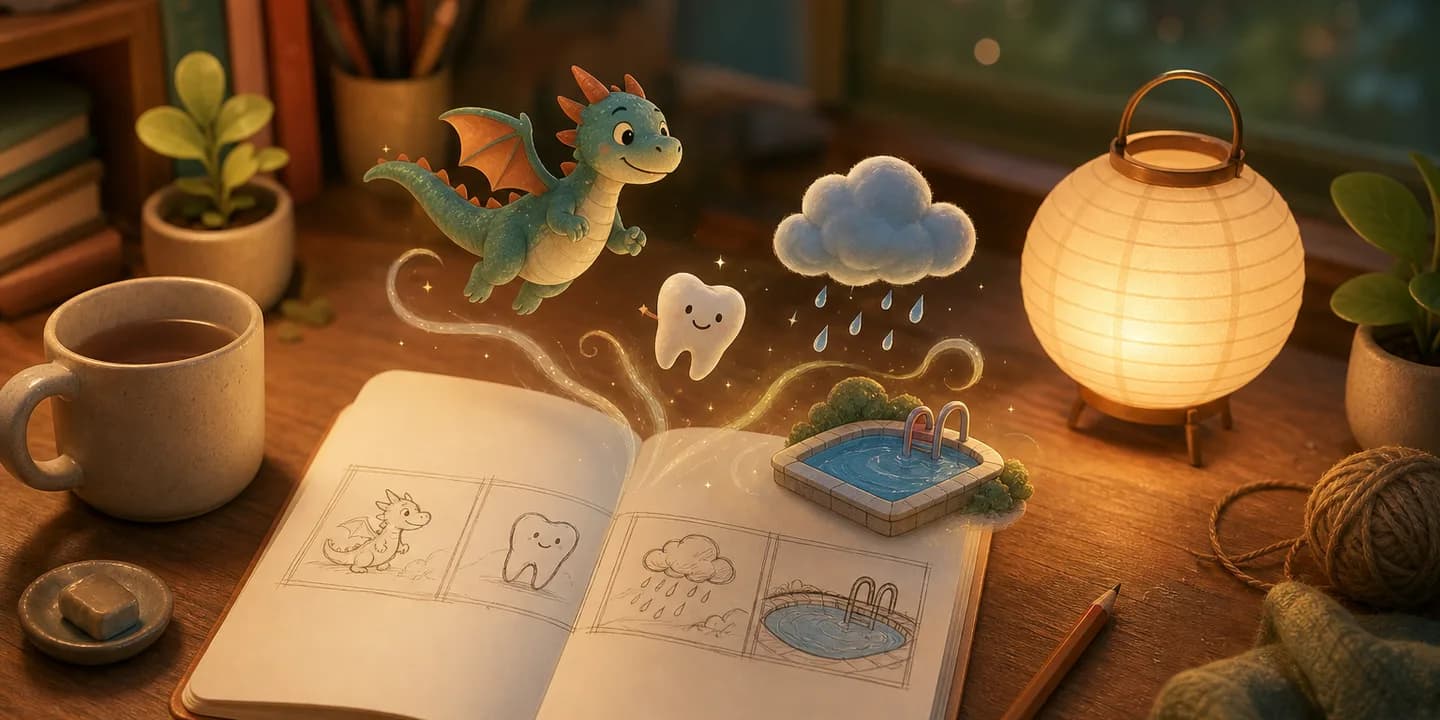
An open notebook on a lamplit desk with four simple story panels sketched in pencil — a dragon, a tooth, a rain cloud and a swimming pool — and the same four rising off the page in full colour
Painted for this article by the same engine that illustrates your child’s book.

The short answer

  • A picture book that works has one small want, one real obstacle, and a change the child can see — not a big adventure.
  • The stake should be the size of the child's actual world: a lost tooth, a first swimming lesson, a new baby. Small is not weak.
  • The hero has to DO the solving. A story where an adult fixes it teaches the opposite of what you wanted.
  • When you brief a story, give one true detail and one feeling — "she was nervous about the swimming lesson but jumped in anyway" is a whole book.
In this article▾
  1. One small want, one real obstacle, one change
  2. Make the stake the size of their world
  3. The child has to solve it
  4. Repetition is a feature, not padding
  5. The ending should settle, not excite
  6. How to say all that in one line
  7. The other details worth giving
  8. Then read it out loud

Ask a parent which book their child asks for and you rarely get the most beautiful one on the shelf. You get a specific, slightly battered one. Those books tend to share a shape — and once you can see it, you can brief a story for your own child in a single sentence.

One small want, one real obstacle, one change#

That is the whole engine of a picture book. Not a quest. Not a moral. A character wants something ordinary, something is in the way, and by the end they are different in a way a four-year-old can see.

The mistake most adults make when inventing a story for a child is going too big. Dragons, kingdoms, the fate of the world. But a small child's imagination does not need scale — it needs recognition. A story about the wobbly tooth that would not come out is more gripping to a five-year-old than a story about saving a planet, because they have a wobbly tooth.

Make the stake the size of their world#

The things that are genuinely enormous when you are four:

  • the first day at a new place
  • the dark, and what is in it
  • a new baby who takes up all the attention
  • a lost toy
  • being the smallest one there
  • a thunderstorm
  • water that goes over your head

Any one of these carries a whole book. They feel small only from up here.

See your child as the hero

Add one photo, tell us what the story should be about, and look at the painted cover. That part is free — decide about the book after.

See it free first

The child has to solve it#

This is the rule that matters most and gets broken most often. If a grown-up arrives and fixes the problem, the story quietly teaches the opposite of the thing you wanted it to teach.

The hero can be helped. They can be frightened. They can need a hand up at the end. But the turn — the moment where it changes — has to be something they do. That is what makes a child carry the story back into real life: "I was brave like in my book" only works if the book's brave bit was theirs.

Repetition is a feature, not padding#

Three tries. A phrase that comes back. A refrain the child can say before you do. Adults read this as filler; children read it as an invitation to participate, and participation is why they ask for the book again. Rhythm you can read aloud without stumbling matters more than a clever sentence you have to concentrate on.

The ending should settle, not excite#

A bedtime story has a job at the end, and the job is downwards. Resolve it, name the feeling, close the loop — the light goes off, the hero sleeps, the day is finished. Save the cliffhanger for a morning book.

How to say all that in one line#

You do not have to write any of this yourself. When you make a book on KindFable you give the story a seed, and the seed is the whole game. The most useful brief has two ingredients:

One true detail + one feeling.

  • ✅ "She was nervous about her first swimming lesson but jumped in anyway."
  • ✅ "He held his baby sister for the first time and whispered hi."
  • ✅ "The thunderstorm last Tuesday, and how she hid under the table with the dog."
  • ❌ "A fun adventure story."
  • ❌ "Something about dinosaurs."

The first three each contain a want, an obstacle and a change. The last two contain a genre. A genre is not a story, and it produces the generic book you were trying to avoid.

The other details worth giving#

  • What they are actually into right now — not what they liked last year. Interests drive the world the story happens in.
  • Who belongs in it. A grandparent, the baby, the dog, the toy that goes everywhere. Up to three companions can be in the book, drawn consistently — and those are the pages children linger on.
  • Whether it really happened. If the moment is real, you can ask for it to be told faithfully rather than turned into a fantasy. The book becomes a family record instead of an adventure.

Then read it out loud#

The final test is not literary. Read the finished book aloud once, at normal speed, and watch what happens at the turn. If your child leans in, the shape worked.

Try it with one real moment — building the story and seeing the painted cover is free — or read a complete sample book first and reverse-engineer the shape for yourself.

Two worked examples: books like Where the Wild Things Are takes apart the best-known turn in picture books, and ten seconds after the goal shows the same shape built from one ordinary afternoon.
About the examples here. The children, photographs and stories in our articles are samples, made by us to show what KindFable produces. Even the “uploaded photo” is AI-generated — it is not a picture of a real child, and no real child appears on this site. We never save a customer’s photo — there is no copy of one to publish here, and no route that would put it here. The books, the narration and the songs are genuine and unretouched, made exactly the way your own book would be.

Questions people ask about this

How do I write a story for my child?
Start from one real moment, not a big idea. Name what your child wanted, what got in the way, and what they did about it. One want, one obstacle, one change — that is the whole shape of a picture book, and it fits in a sentence.
What makes a good bedtime story?
A small, recognisable stake, a hero who solves it themselves, a rhythm you can read aloud without stumbling, and an ending that settles rather than excites. Bedtime stories should land softly — save the cliffhanger for the morning.
How long should a children's story be?
For a picture book, roughly twelve to fourteen illustrated spreads with one or two sentences on each. That is about five minutes read aloud, which is the length a three-to-seven-year-old will sit for and then ask to hear again.
  • #how to write a children's story
  • #children's story structure
  • #picture book plot
  • #story ideas for kids
  • #writing a bedtime story
Share this guide

Written by the KindFable team. Every example here is a book we actually made.

Previous articleA Book for a Child Starting School — Why It Helps, and How to Make One About Your ChildNext articlePersonalized Children's Book With Photo: A Full Case Study

In this article

  1. One small want, one real obstacle, one change
  2. Make the stake the size of their world
  3. The child has to solve it
  4. Repetition is a feature, not padding
  5. The ending should settle, not excite
  6. How to say all that in one line
  7. The other details worth giving
  8. Then read it out loud

See your child as the hero

Build the story and see your child’s painted cover, free. Decide about the book after that.

Start free

Read next

  • A first birthday table after the party, with a board book lying open at its blank front page beside a plate of squashed cake and a one-year-old's hands reaching across it
    Gifts

    First Birthday Book Gift: What to Buy and What to Write

    A first birthday book gift is really for the next three years, not the day. What to buy so it survives, what to write in it, and which nine books earn it.

    Aug 16, 202612 min read

    Read →
  • A parent and a small child on a bed at night, a hand-stitched storybook open between them, a lamp throwing warm light across the page
    Bedtime

    How to Make a Bedtime Storybook: 6 Steps

    How to make a bedtime storybook your child asks for again — what to write, how long it should be, and how to turn one night's story into a printed book.

    Aug 24, 20269 min read

    Read →
  • A girl waving beside a glowing crescent moon and a smiling golden star in a felt bedroom, on the cover of a personalised storybook
    Bedtime

    Personalized Storybook for Bedtime: Built From One Wish

    What a personalized storybook looks like when it grows from a bedtime ritual — a four-year-old, the moon, and one wish. Read and hear the whole book free.

    Aug 3, 20267 min read

    Read →

AI-powered

Turn tonight's bedtime story into a real book

Add a photo and tell us what the story should be about — the swimming lesson, the new puppy, the tale you invented at bedtime. We'll write and paint it, with everyone who belongs in it.

Start your story Or pick a ready-made book
  • Listen as an audiobook
  • Or a song from the story

Free to start · we never save your photo, only the drawing.

KindFable

Personalized children’s storybooks starring your child, made from your photos.

Explore

  • Pricing
  • Personalized story books
  • Personalized book with photo
  • Blog
  • All articles
  • About

Reading guides

  • Best children's books
  • Bedtime stories for kids
  • Personalized audiobook for kids
  • Personalized storybook

Support

  • FAQ
  • Shipping
  • Refund policy

Legal

  • Terms
  • Privacy
  • Your privacy choices

Story ideas, once a month — and $5 off your first book

One email a month, unsubscribe in one click.

© 2026 KindFable · Coquitlam, British Columbia, Canada

support@kindfable.com