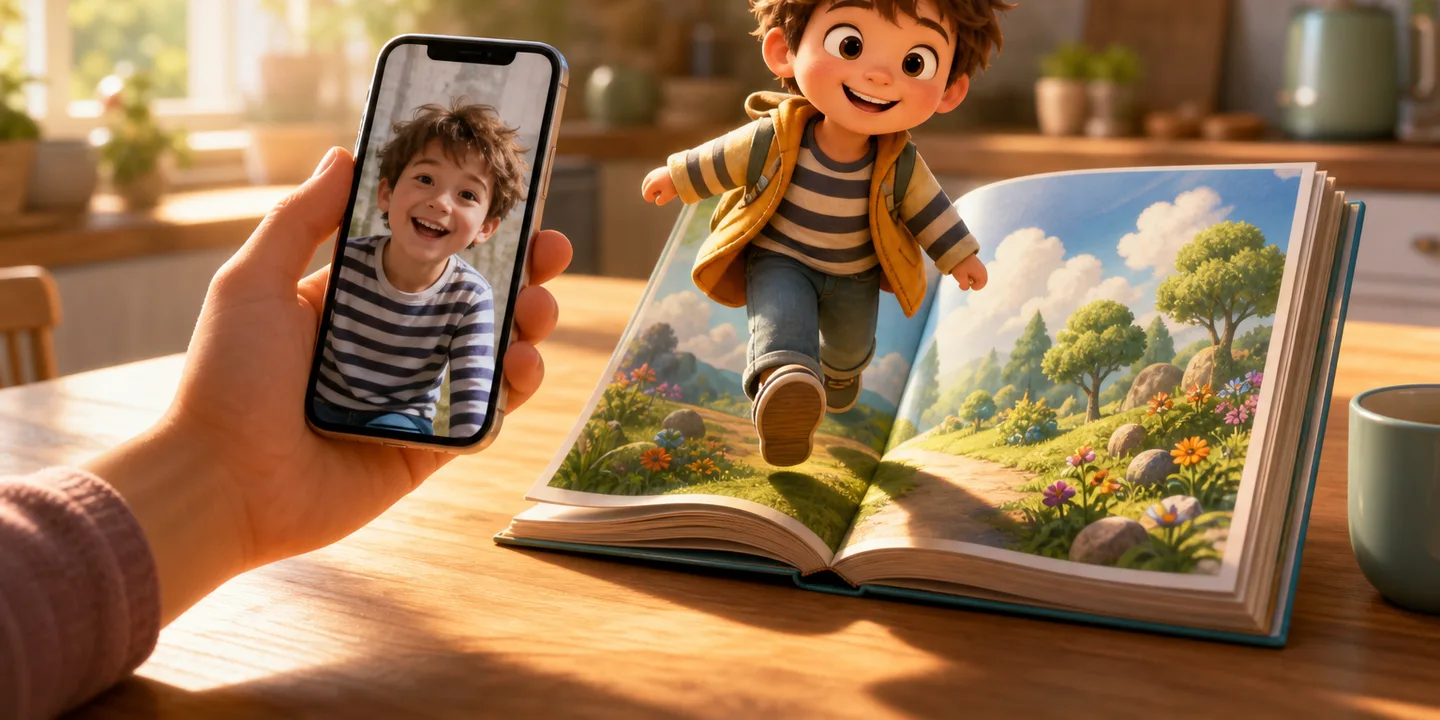
A personalized children's book with photo is a picture book where your child is the hero, drawn from a photograph you upload instead of chosen from stock art. This article follows one from start to finish: the photo that went in, the six sentences the mother typed, and the 13-spread book that came back 4 minutes 32 seconds later, with a narration and a song.
You can read the whole book and hear both further down. Nothing here is a mock-up.
What did the parent actually write?#
Maddox is five and plays minor hockey in Calgary. One Saturday he scored the first goal of his life. This is what his mother typed into the story box, unedited:
Maddox scored his first ever goal at hockey on Saturday morning. He's been on the ice since September and this was the first one. He didn't even celebrate, he just skated back to the bench looking completely stunned, and then about ten seconds later it hit him and he screamed. The whole rink heard it. He has worn the jersey every day since, including to bed.
Six sentences. Almost no adjectives. She was not trying to write anything.
Why is the goal not the story?#
Most parents making a sports book write about the goal. It is the obvious moment — the one everyone clapped for.
But look at where she actually spends her words. One sentence on the goal. Four on everything around it: the months of not scoring, the not-celebrating, the ten-second delay, the scream, the jersey that will not come off.
She was not describing an achievement. She was describing a five-year-old's face doing arithmetic — the gap where something enormous has happened and the child has not caught up with it yet. Any parent who has watched a small child receive good news knows that pause exactly.
That pause is the book. The goal is only what makes it possible.
The rule this gives you#
When you are staring at the story box, the useful question is not what was the big thing that happened this week? It is: what did I notice that nobody else in the room did?
That is almost always the book.
What came back?#
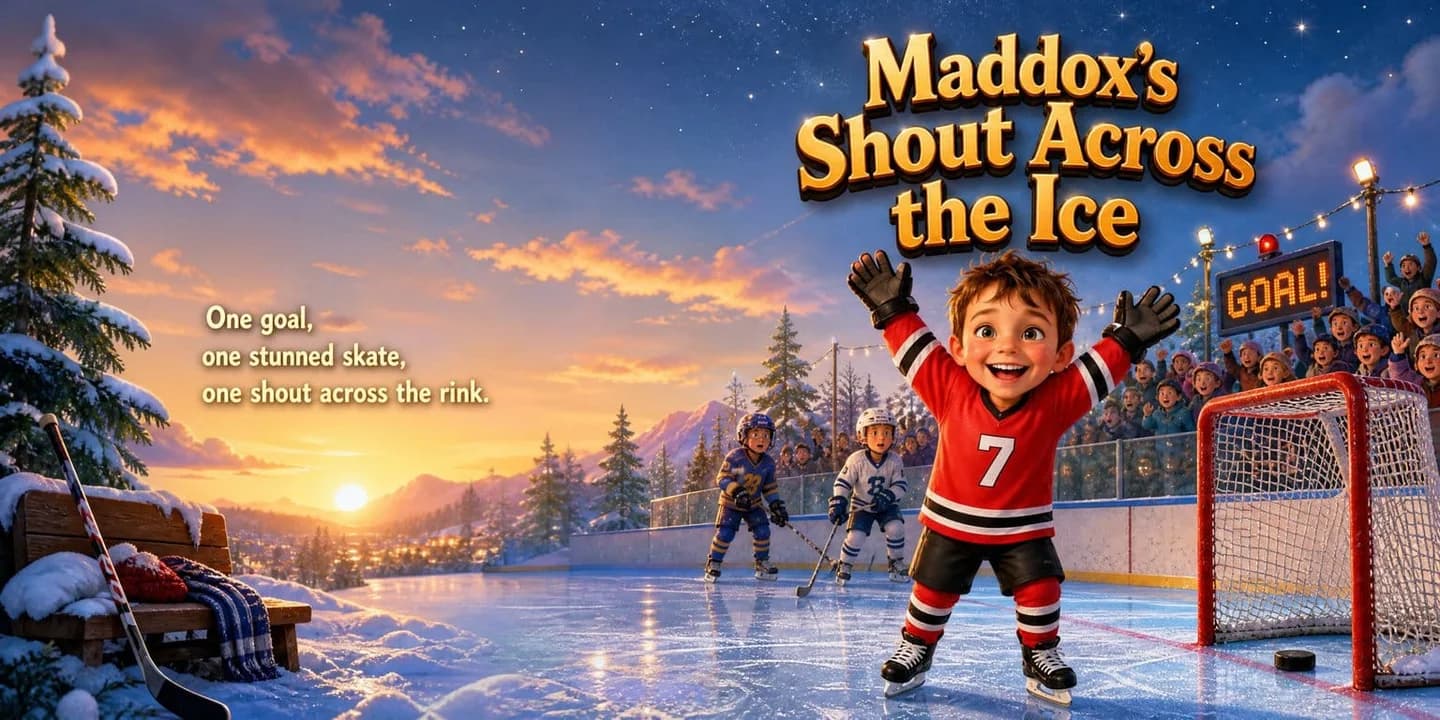
The finished book is called Maddox's Shout Across the Ice, and it does what her note does — it slows down at the pause.
The puck crosses the line on one spread. On the next he skates back to the bench and does not celebrate. On the next the rink is quiet and he is sitting there holding his stick. Then ten seconds pass, his mouth opens, and the noise arrives.
Four pages for ten seconds. The last page is the jersey, worn to bed, because that is where her note ended too.
Why do small details matter more than good writing?#
There is a temptation to make the note sound like a story — to add adjectives, to explain that he was brave, that he had worked hard, that it was a special day.
Don't. Those are the parts a stranger could have guessed.
What no stranger could invent is that he didn't celebrate. That there was a gap. That the jersey came to bed. Those are the details that make a child, three years later, look at the page and know it is genuinely about them rather than about a generic child with their name printed on it.
Reading researchers have made a version of this point for years: the National Literacy Trust reports that children who see themselves and their own lives reflected in books are markedly more likely to enjoy reading and to keep doing it. A book about your Saturday is not a novelty item — it is the kind of book that gets re-read.
How does one photo become the same child on every page?#
His mother uploaded one picture. Not a good one — a phone snapshot in a living room, hair everywhere, mid-laugh.
The actual book
Read it, and hear it
Everything below is the finished book — not a mock-up, not a selection of the good pages. The narration and the song are the ones the family received.
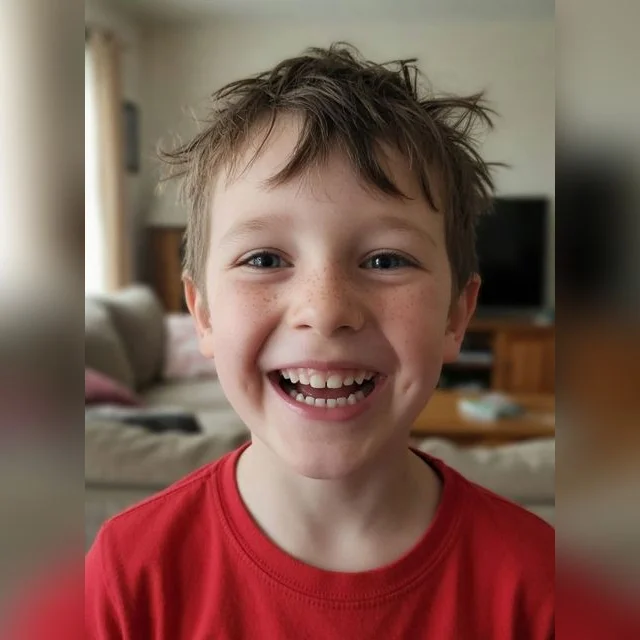
The photo they uploaded
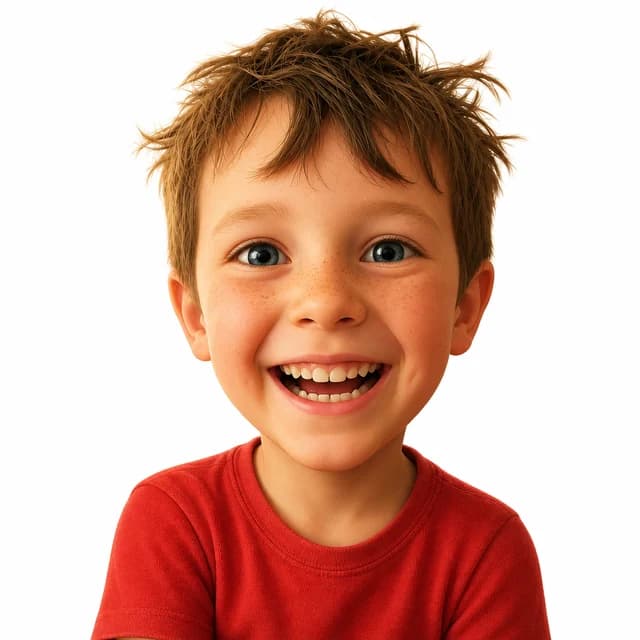
The character we drew
The whole book read aloud, the way it arrives with a hardcover.
Written from this story — not a stock track with a name dropped in. Free with every book.
The full story, in text
- 1Saturday morning, Maddox stepped onto the ice, his hockey jersey tucked close beneath the rink lights.
- 2He had skated since September, waiting and waiting for his first goal.
- 3The puck slid ahead. Maddox chased it, knees bent, skates whispering over the bright ice.
- 4He tapped the puck towards the net, then followed it between the painted lines.
- 5The puck crossed the line. Maddox scored his first ever goal.
- 6For one quiet moment, he did not celebrate. He skated back to the bench, stunned.
- 7Skate on, Maddox. His stick lowered, and his wide eyes stayed fixed on the net.
- 8Ten seconds passed. Then Maddox understood what had happened, and his mouth opened wide.
- 9His scream burst across the rink. Every player and watcher heard it.
- 10His shout rolled around the boards. Maddox stood still, holding his stick.
- 11The whole rink heard Maddox's first goal. His shout filled every corner.
- 12Since Saturday, Maddox has worn his hockey jersey every day, even to bed. Skate on, Maddox.
The words to the song
[Verse 1]
Saturday morning, Maddox skated on the ice
His hockey jersey tucked in nice
Since September, he waited for his goal
The puck slid on, and Maddox chased it whole

[Chorus]
Skate on, Maddox, skate on bright
Tap the puck and aim just right
Maddox scored his first ever goal
His big shout filled the rink as a whole

[Verse 2]
The puck crossed the line, then Maddox skated back
He stood still, with his stick held slack
Ten seconds passed, then he knew
His shout rolled round the boards too

[Chorus]
Skate on, Maddox, skate on bright
Every player heard his delight
The whole rink heard his first goal
His shout filled every corner whole
The mechanism matters, because it is where most tools fall down. The photo is turned into one character drawing, and that drawing — not the photo — becomes the reference for every single spread. That is why he is the same boy on the last page as on the first, rather than a slightly different child each time.
We never save the original photo — not to our storage, our database or our logs — which is why no real child's photo appears anywhere on this site. It is sent to our AI provider in the United States to be checked and drawn, under that provider's own terms; only the drawing is kept.
What makes a photo work?#
This is the question we are asked most, and the answer is duller than people expect. A good source photo needs three things, and none of them is quality:
- The whole face, straight on. Nothing covering it — no sunglasses, no hat brim, no hand near the chin. Everything the drawing keeps comes from the face, so anything hidden is guessed at instead.
- One child in frame. Two faces means the drawing has to choose, and it may choose wrong.
- Ordinary light. A living room by a window beats a studio portrait. Harsh shadow across half a face costs more than a slightly blurry phone camera does.
That is the entire list. The photo used for this book is a mid-laugh phone snapshot with the television visible behind him, and it worked perfectly.
Does the child get dressed for the activity?#
Yes, and it is worth stating because it is the thing that usually goes wrong elsewhere.
Maddox is in proper kit on every spread — jersey, padded shorts, striped socks, real skates — not in the t-shirt he happened to be wearing in the photo. When you tell us the story is about a sport, the character is dressed for it before the first page is drawn.
A book about hockey where the child plays in trainers is a book a five-year-old will notice immediately. Minor hockey is a serious business in Canada: Hockey Canada registers well over half a million players a season, and most of them are children who know exactly what skates look like.
How do you make one? The nine steps#
There is no trick to this. The typing took her about four minutes.
1. Open the create page. No account, no card, nothing to sign up for first.
2. Type the child's name and age. Maddox, 5. Age matters more than it looks: it sets sentence length and pacing, so a five-year-old's book does not read like an eight-year-old's.
3. Upload one photo. The living-room snapshot above. It only has to show the whole face, straight on, with nothing covering it.
4. Tick the consent box. One line confirming the child is yours and you are happy for the photo to be used to draw them. A child's face is not something to be casual about.
5. Type what happened in the story box. Her six sentences, exactly as they came out. She did not tidy them up.
6. Choose an art style. Nine are available — see the guide to the nine art styles if you are undecided. She chose 3D Cartoon because it looks like the films Maddox already loves. That is genuinely the whole basis for the decision, and it is the right one.
7. Wait for the cover. You see the finished, painted cover of your book before being asked for anything. If the child on it does not look like your child, you stop there and it has cost you nothing.
8. Choose the format. She chose the hardcover, which includes two audio credits — the narration and the song — at no extra cost. If you are weighing the options, hardcover, softcover or digital compares them.
9. The book is made. 4 minutes 32 seconds later: 13 spreads, a 4-minute 3-second narration, and a 1-minute 5-second song.
One photo, six sentences, two decisions.
What do you get afterwards?#
Once the book exists it lives in your dashboard, and so does everything you can do with it:
- The reader — the same page-flip book embedded above, on any device.
- The audio studio — the narration and the song, with the words shown so a child can sing along. Narration and song are one credit each; the hardcover includes two.
- Reordering — a second copy for a grandparent, without rebuilding anything.
- Your library — every book you have made, so the next one can reuse the same character rather than starting from a new photo.
What does the AI actually do?#
Three jobs, and it is worth being precise about them rather than saying "AI" and moving on:
- It draws a character from the photo, once, and then references that character on every page. Consistency is a reference-chain problem, not a prompting trick.
- It writes the story from your note — the real events, in their real order. Nothing is invented on top of a real memory when you ask for a true retelling.
- It reads the book aloud and writes a song from that story, not from a template with a name dropped into it.
You can make one of these#
Not "something like this" — this. The same nine styles, the same page-flip book, the same narration and song with a hardcover, from one photo of your child and a few lines about your week.
Start with a personalized children's book with a photo, or read how a photo becomes an illustrated hero first.
And if what happened this week was a goal — write about the ten seconds afterwards.